
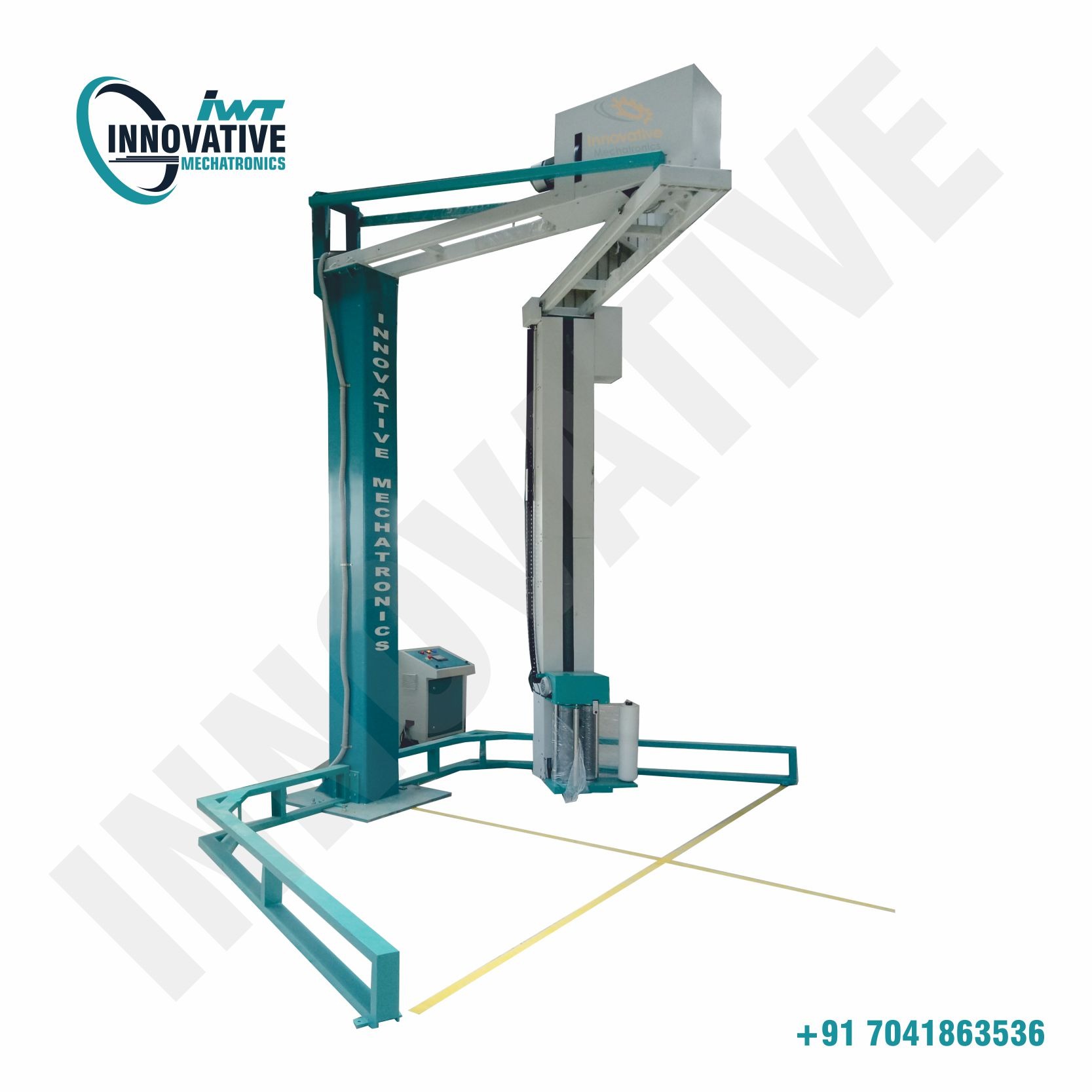
Boost your packaging line with Innovative Mechatronics advanced Rotary Arm Stretch Wrapping Machine. Our heavy-duty system keeps pallets completely stationary while a high-speed arm wraps them, eliminating toppling risks for unstable or heavy loads.
Maximize film savings by up to 40% with our 300% powered pre-stretch technology. Featuring a robust PLC interface and seamless conveyor integration, our systems deliver unmatched precision and reliability. Visit WrappingMachineOnline to transform your end-of-line operations!
Engineered for demanding industrial production lines, the Rotary Arm Stretch Wrapping Machine is a heavy-duty packaging system designed to unitize and stabilize palletized loads securely. Unlike traditional turntable wrappers where the product spins, the rotary arm design keeps the pallet completely stationary on the floor while a dynamic mechanical arm revolves around it.
Manufactured by industry leaders like Innovative Mechatronics (WrappingMachineOnline), these systems deliver maximum load stability and packaging integrity.
1. What is the Rotary Arm Stretch Wrapping Machine & How It Works?
A Rotary Arm Stretch Wrapping Machine is an advanced secondary packaging system that wraps LLDPE stretch film around a motionless pallet by revolving a film-dispensing carriage via a rotating overhead or floor-mounted arm.
Step-by-Step Operational Workflow
-
Pallet Positioning: A forklift, pallet jack, or automated conveyor moves the loaded pallet into the wrapping zone, halting it precisely in the center.
-
Film Attachment: The operator or automated clamp secures the stretch film tail to a corner of the pallet base.
-
Rotary Arm Activation: The drive motor activates, spinning the balanced mechanical arm smoothly around the stationary load.
-
Powered Pre-Stretch Application: As the arm rotates, dual-roller pre-stretch mechanisms elongate the film by 250% to 300%, activating its elastic memory.
-
Vertical Carriage Travel: Simultaneously, the up-down drive system guides the film carriage vertically along the structural mast, applying a uniform spiral wrap from the bottom to the top.
-
Reinforcement Cycles: The PLC controller triggers programmed top and bottom reinforcement wraps to lock the load securely onto the wooden pallet.
-
Film Cutting & Sealing: Upon completion, the pneumatic cutting assembly sears or cuts the film cleanly, and a wiper pad presses the tail tightly against the load.
-
Pallet Exit: The wrapped, rock-solid pallet clears the wrapping zone for dispatch or warehouse storage.
Why This Machine is Critical in Modern Industrial Operations
In high-throughput industrial plants, packaging failure leads directly to product damage, costly transit claims, and safety incidents. Rotary arm machines are essential because they eliminate centrifugal force risks.
When tall, unstable, lightweight, or fluid-filled loads spin on a high-speed turntable, centrifugal forces frequently cause them to lean, shift, or topple. By keeping the pallet completely stationary on the floor, rotary arm wrappers eliminate this issue entirely, allowing facilities to wrap unstable or exceptionally heavy loads at high speeds safely.
Types, Variants, and Ideal Use Cases
Plant managers can select from three main variants depending on layout and throughput requirements:
-
Semi-Automatic Rotary Arm Wrappers: Requires an operator to position the pallet and anchor the film tail before initiating the cycle via push-button.
-
When to use: Medium-volume plants handling diverse, oversized, or irregular SKUs.
-
-
Fully Automatic Rotary Arm Wrappers: Integrates completely with automated roller or chain conveyors, managing film clamping, cutting, and pallet transport with zero human intervention.
-
When to use: High-speed, continuous-flow manufacturing and distribution lines.
-
-
Wall-Mounted / Ceiling-Suspended Variants: Designed for facilities with tight floor space constraints, freeing up valuable floor real estate around the packaging zone.
-
When to use: Facilities with narrow footprints or specialized cleanroom configurations.
-
Key Technical Features & Real Operational Benefits
| Technical Feature | Real Operational Benefit |
| Powered Pre-Stretch Carriage (Up to 300%) | Cuts film consumption by up to 40% while maximizing holding force. |
| Stationary Load Architecture | Eliminates tipping and shifting risks for tall, fluid-filled, or unbalanced loads. |
| Intuitive PLC Touchscreen Interface | Enables quick customization of wrap patterns, top/bottom counts, and arm speeds. |
| Photo-Eye Auto-Height Sensor | Automatically detects pallet height without manual operator measurement. |
| VFD-Controlled Drive Motors | Ensures jerk-free soft starts and stops, protecting delicate cargo from sudden shocks. |
How to Choose the Right Model
When selecting a Rotary Arm Stretch Wrapping Machine, evaluate these four core criteria:
-
Capacity: Match the weight and height limits to your heaviest and tallest pallet profiles.
-
Material: Ensure the pre-stretch carriage accommodates your preferred LLDPE film thickness and stretch grade.
-
Automation Level: Choose semi-automatic for flexible, operator-assisted cells or fully automatic for inline conveyor integration.
-
Budget: Factor in long-term ROI derived from saved film and reduced labor overhead rather than just upfront equipment cost.
Rotary Arm Wrapper vs. Manual or Alternative Methods
-
Versus Manual Wrapping: Manual hand-wrapping is labor-intensive, physically exhausting, inconsistent in tension, and wastes massive amounts of film. Rotary arm machines deliver uniform tension, protect worker ergonomics, and cut film usage significantly.
-
Versus Turntable Wrappers: Turntable wrappers spin the load, restricting them from handling heavy, unbalanced, or towering pallet stacks due to centrifugal tipping hazards. Rotary arm wrappers keep the load completely stationary, safely accommodating heavy or unstable loads at high speeds.
Why Choose Manufacturing Excellence from Innovative WrapTech?
-
In-House Engineering & Customization: We understand that every industrial facility has unique layout constraints and load profiles. Our engineering team customizes machine dimensions, arm speeds, and conveyor heights to fit your exact floor specifications.
-
Rugged Heavy-Duty Build: Built with high-grade structural steel and precision components, our rotary arm wrappers are designed for 24/7 continuous operation in harsh industrial environments.
-
Advanced Automation & PLC Integration: Equipped with user-friendly touchscreen interfaces and smart photo-eye sensors, our machines integrate effortlessly into automated factory lines.
-
Comprehensive End-to-End Support: From initial site assessment and custom fabrication to installation, operator training, and readily available spare parts, we stand by our products throughout their operational lifecycle.
FAQs
Q1: Why choose a rotary arm wrapper over a turntable?
A: Rotary arm machines keep the pallet completely stationary, eliminating centrifugal force. This prevents tall, heavy, or unstable loads from toppling—a common issue with spinning turntables.
Q2: How does powered pre-stretch save money?
A: It elongates the film by up to 300% before application, activating its elastic memory. This cuts annual film consumption by 30% to 40% while maintaining superior load holding force.
Q3: Can it integrate into automated conveyor lines?
A: Yes. Fully automatic variants integrate seamlessly with roller or chain conveyors, handling pallet positioning, film clamping, cutting, and discharge with zero human intervention.
Q4: What are the electrical and utility requirements?
A: It requires a stable 415V AC (3 Phase + Neutral + Earthing) power supply and robust grounding to protect sensitive PLCs and VFDs. Pneumatic models also require a clean compressed air supply (6 bar).
Q5: What routine maintenance is required?
A: Daily cleaning of optical sensors and checking pneumatic lines; weekly lubrication of guide tracks and chain drives; and quarterly audits of electrical terminals and safety systems.
